The Western Balkans Move from Energy Transition to System Delivery
11 March, 2026
The energy transition in the Western Balkans enters the delivery phase
The energy transition in the Western Balkans is entering a new phase. Targets, strategies and policy alignment are no longer the main constraint. The defining challenge now is delivery at system scale.
Across South-East Europe, rapid renewable deployment has exposed structural weaknesses in electricity grids, market design and system flexibility. The Western Balkans face similar pressures, but they also have a narrow window of opportunity to design the next phase more effectively.
With lower renewable saturation levels, growing cross-border interconnection plans and increasing alignment with European energy frameworks, the region can build a more resilient energy system while avoiding mistakes already experienced in other markets.
Regional policy coordination is already taking place through initiatives led by the Energy Community, which supports regulatory alignment between the Western Balkans and the European Union.
Grid congestion and system constraints are becoming visible
As renewable capacity grows, system limitations are becoming increasingly clear.
Grid congestion, connection queues and rising balancing costs are no longer theoretical risks. They are predictable outcomes when renewable deployment outpaces the modernization of electricity infrastructure.
Several European markets have already experienced these pressures. The key lesson is clear: generation expansion must be matched with system upgrades.
According to energy system analyses published by the European Commission, large-scale renewable integration requires parallel investments in grids, flexibility and digital infrastructure.
Without these investments, energy systems risk facing higher costs, curtailment and market inefficiencies.
Five key challenges shaping the energy transition in the Western Balkans
As the energy transition in the Western Balkans accelerates, several structural challenges are emerging that will define how resilient the region’s energy system will become.
Five key system challenges include:
Grid readiness
Transmission and distribution networks must be upgraded to accommodate increasing renewable capacity and cross-border electricity flows.
Market design
Electricity markets need to evolve to support variable generation, flexibility services and efficient price signals.
Storage integration
Battery storage and other flexibility solutions will play a critical role in balancing renewable generation and stabilizing power systems.
Regional electricity trading
Stronger cross-border electricity flows and improved regional market integration will be essential for system stability and efficient resource allocation.
Long-term infrastructure planning
Renewable deployment must be aligned with long-term grid expansion, interconnection development and system planning.
From renewable deployment to system architecture
The regional conversation is gradually shifting from renewable targets to system architecture.
Instead of focusing only on project pipelines, policymakers, utilities and investors increasingly need to consider the entire energy system: generation, grids, storage and market mechanisms.
Treating energy infrastructure as an integrated system rather than isolated assets will be critical for long-term resilience.
A key moment for the Western Balkans energy sector
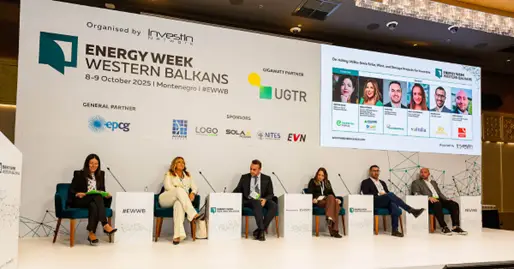
Energy Week Western Balkans 2026 takes place at an important moment for the region’s energy sector.
As the energy transition in the Western Balkans accelerates, the conversation is moving from ambition to implementation.
The event brings together policymakers, utilities, investors and technology providers to discuss how the region can build integrated, flexible and resilient energy systems capable of supporting large-scale renewable generation.
Related News


